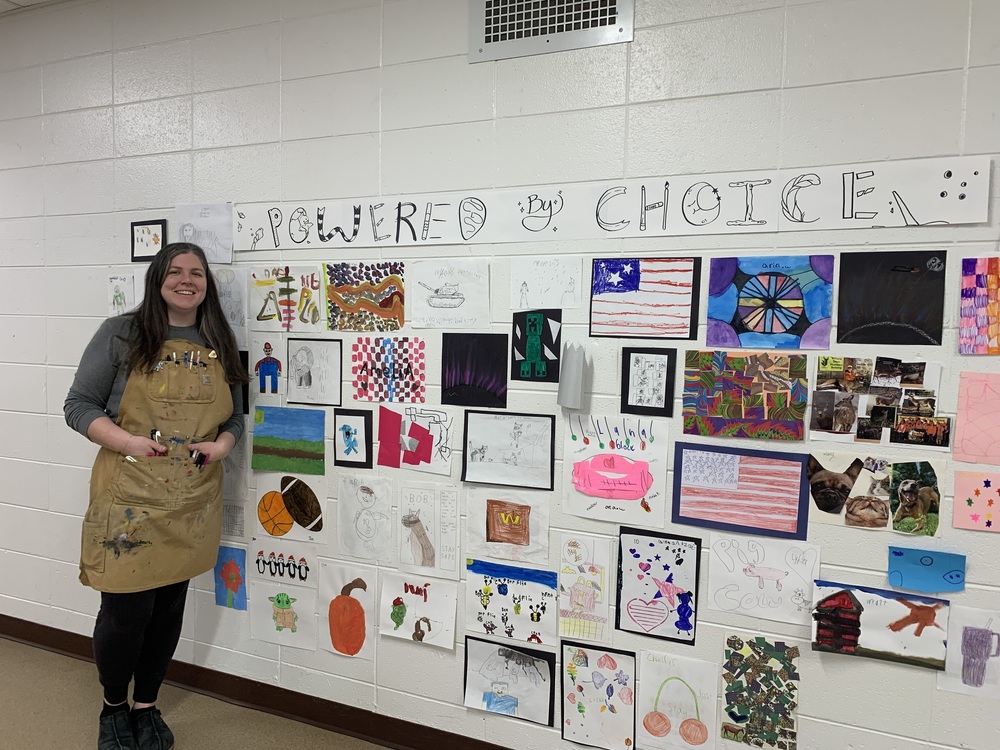
The moment elementary students step into Mrs. Haverland’s art studio, they don’t ask, “What are we making?“ but instead ask, “What can I create?¨ When a student walks into the art classroom, they don't sit down in their assigned seats to complete a step-by-step project that looks the same as the students around them. Instead, they go and get their portfolios full of their own work, their ideas, and projects that are waiting to come to life, each one unique from the students around them.
Mrs. Haverland has been teaching since 2013, but for the past five years, she has dedicated herself to art education here at Potosi. While she follows the Wisconsin Visual Arts Standards, her classroom looks and works differently from the traditional elementary art room. This is because she has made the thoughtful decision to use the TAB approach - Teaching for Artistic Behavior - a philosophy built on one core belief: students are artists.
“Students take ownership of their art experience,” she explains. “They choose their medium, their projects, and their pace.”
Traditional art instruction is teacher-led, with students replicating a finished product designed by the teacher. While Mrs. Haverland acknowledges that there is learning in that technique, she quickly felt that it wasn't enough for her classroom. In her early teaching career, she experimented with structured, teacher-designed projects but often felt the limitations of this method.
“I had students who loved painting and students who didn’t care for it. I had students who wanted to grow their observational drawing skills and students who wanted to build a football field out of cardboard,” she says. “I simply could not meet all their needs and desires with my teacher-led product art.”
After research, trial and error, and listening to feedback, she chose to transition to a choice-based classroom. This was very rewarding. She watched students gain skills like problem-solving, pivoting, trying new things, and growing confidence in their own ability.
“There’s no right answer,’” Mrs. Haverland says. “My job isn't to tell them how to fix something. It’s to give them the tools and confidence to figure it out.”
Even though it was very rewarding, it did and still has its trials. Managing a variety of supplies for 165 elementary students and storing all of their works in progress was a struggle that required her to create systems and rely on those in her community to help with this problem.
There has also been a situation where adults have questioned this approach. “How can this be called art?” some ask when projects don't resemble the neatly replicated pieces often displayed at concerts.
Her response is simple: those projects often replicate how well students follow directions. But in her classroom, it is different; she wants her students to think independently, solve problems, and trust themselves.
The positive growth is visible; students who once didn't know what to do now mix, use, and clean up paint independently. Instead of second-guessing themselves, they dive into their ideas.
Mrs. Haverland has felt the fruits of her labor; she claims that the energy is magical.
“Walking around the studio with 100% of my students working on their projects is one of the most rewarding experiences,” she shares. “They are all so creative, and I'm happy I can support them on their journey.”
Beyond artistic skill, she hopes students leave with something deeper: resilience. She wants them to take risks, make mistakes, pivot when things don't go as planned, and understand that not being good at something the first time is part of the creative process.
Years from now, when students think back on their time at Potosi, Mrs. Haverland hopes they remember one simple truth. “I hope they remember they are artists,” she says. “I want them to look back and smile.”
Mrs. Haverland's classroom isn't about making a product for adults; it's about creating something meaningful and, in the process, discovering confidence that stretches far beyond the studio walls.